
What Is Abella Danger’s Net Worth? A Complete Breakdown of Her Wealth
June 29, 2026Donna Gay Glover Biography: The Life Story of Steve-O’s Mother
July 1, 2026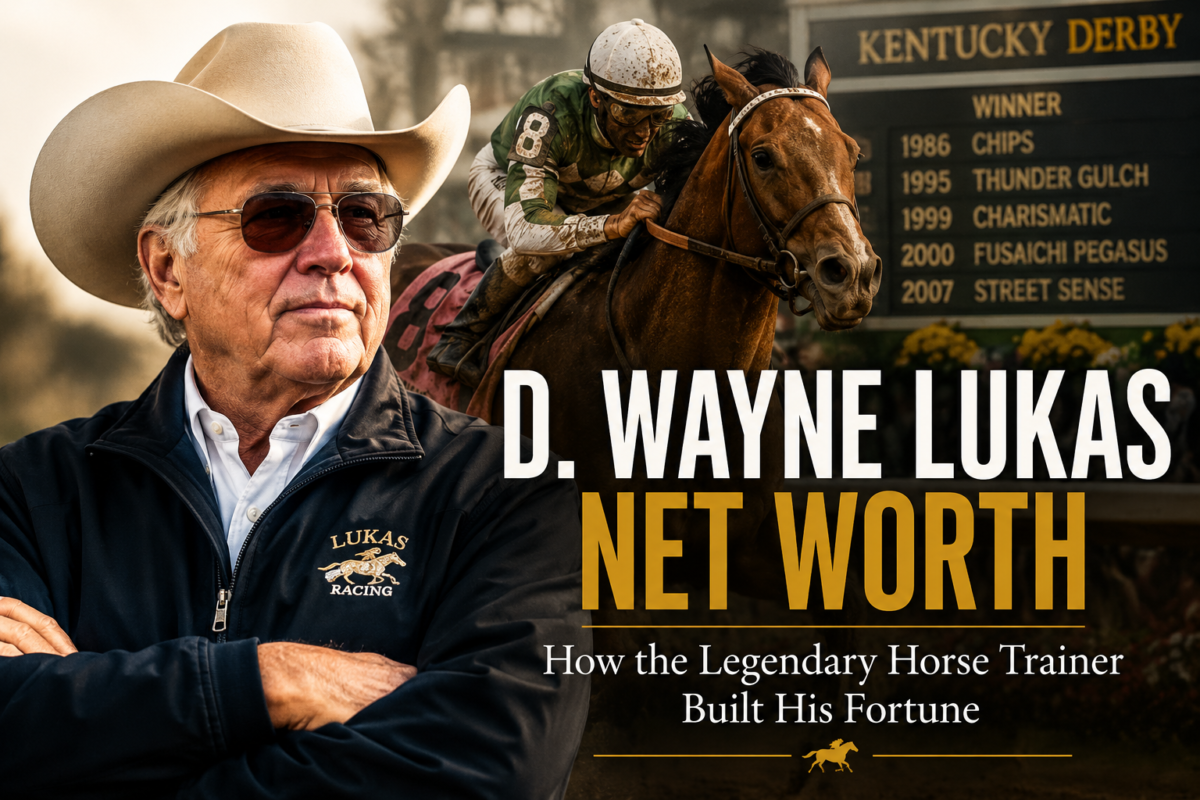
D. Wayne Lukas did not build his fortune like a celebrity athlete, a team owner, or a Wall Street investor. He built it in the pre-dawn hours of racetracks, in sales rings where million-dollar decisions were made in minutes, and in barns where the difference between a champion and an expensive disappointment often came down to judgment, discipline, and timing. For decades, Lukas was not merely a trainer; he was the architect of a modern racing operation that changed how elite stables were organized, marketed, and scaled.
That is why the question of D. Wayne Lukas net worth is more complicated than a simple dollar figure. Public estimates vary widely, and most should be treated with caution because a racehorse trainer’s personal wealth is not the same as the purse money earned by horses under his care. Lukas’ horses generated more than $300 million in career purse earnings, but that money was split among owners, jockeys, trainers, staff, taxes, expenses, and reinvestment into racing operations. His real wealth came from decades of training fees, purse percentages, owner relationships, bloodstock influence, brand power, and a career-long position at the center of American horse racing’s most lucrative events.
By the time Lukas died on June 28, 2025, at age 89, he had become one of the most consequential figures in the history of the sport. He won 15 Triple Crown races, captured a record-tying 20 Breeders’ Cup victories, trained multiple Horses of the Year, and helped professionalize racing in a way that still shapes the business today. His fortune, then, cannot be understood only through net worth estimates. It must be understood through the empire he built: a national racing machine powered by elite horses, wealthy clients, relentless ambition, and a management style that turned a traditional barn into something closer to a high-performance corporation.
What Was D. Wayne Lukas’ Net Worth?
D. Wayne Lukas’ exact net worth was never publicly confirmed. Unlike athletes with disclosed contracts or executives with public stock filings, horse trainers usually do not have transparent financial records. Most online estimates place his net worth somewhere in the tens of millions, while some less reliable sources claim much higher figures. The safest interpretation is that Lukas was a very wealthy racing professional, but his personal fortune should not be confused with the more than $300 million in purse earnings accumulated by horses he trained.
A realistic analysis has to begin with how money works in horse racing. When a horse wins a major race, the purse is distributed primarily to the owner. The trainer typically receives a percentage of the owner’s share, often around 10 percent, though arrangements can vary. Trainers also earn day rates for managing horses, receive bonuses, and benefit from long-term relationships with major owners. Over a career as long and successful as Lukas’, those income streams could produce substantial wealth.
But the sport also has extraordinary expenses. Elite training operations require assistant trainers, exercise riders, grooms, veterinarians, blacksmiths, transport, insurance, feed, equipment, and administrative support. Lukas did not run a small local barn. He built a national operation with horses competing across the country. That structure created enormous earning potential, but it also required continuous reinvestment.
The best way to understand D. Wayne Lukas’ net worth is not to chase a single speculative number. It is to study the business model behind his fortune. He was wealthy because he trained valuable horses for wealthy owners, won the sport’s biggest races, commanded trust in the bloodstock market, and became one of the few trainers whose name itself carried commercial power.
The Foundation: From Teacher and Coach to Racing Entrepreneur
Before Lukas became “The Coach” of American horse racing, he was literally a coach. He worked as a teacher and basketball coach in Wisconsin before moving fully into horse training. That background mattered. His later success was built not only on horsemanship but also on organization, motivation, delegation, and competitive psychology.
Lukas began his professional horse career in Quarter Horse racing, where he quickly became dominant. According to the American Quarter Horse Association, he began training Quarter Horses full time in 1968 and produced 24 world champions over the next decade. That early period gave him two advantages. First, it taught him how to identify speed and manage high-performance animals under pressure. Second, it gave him credibility with owners who were willing to spend serious money.
When Lukas moved into Thoroughbred racing, he brought with him a more aggressive, business-minded style than many traditional trainers. He was willing to travel, willing to run horses in ambitious spots, and willing to manage a large stable across different racing circuits. In a sport where many barns were built around local relationships and conservative placement, Lukas saw opportunity in scale.
That transition became the foundation of his fortune. He was not simply training horses; he was building a national platform. By the 1980s, he had become one of the most commercially powerful trainers in the country, leading the sport in earnings for long stretches and attracting elite clients who wanted access to his system.
How Lukas Made Money in Horse Racing
A top trainer’s income comes from several sources, and Lukas benefited from nearly all of them. The most visible source was purse money. When his horses won the Kentucky Derby, Preakness Stakes, Belmont Stakes, Breeders’ Cup races, and major graded stakes, those victories generated large purses. Trainers typically earned a percentage of those winnings, giving Lukas a direct financial incentive tied to elite performance.
The second major source was daily training fees. Owners pay trainers to care for and condition their horses. These fees may not sound as glamorous as winning the Kentucky Derby, but for a large stable, they can create steady, recurring income. A trainer with dozens or even hundreds of horses under management can generate significant revenue before prize money is even considered.
The third source was reputation. Lukas’ name gave owners confidence. A horse trained by Lukas was attached to a brand that meant ambition, national visibility, and a chance at major races. That reputation helped him attract better horses, and better horses created more victories, more purse money, and more demand for his services.
The fourth source was influence in the bloodstock market. Trainers often advise owners on which horses to buy, how much to spend, and which young prospects have championship potential. Lukas’ eye for talent and his record with young horses made his judgment valuable. Even when he was not the owner, his role in shaping purchase decisions gave him influence in an industry where one great horse can become worth millions.
His financial power came from combining all these streams. He earned from the daily mechanics of training, the upside of winning, and the long-term value of being trusted by wealthy owners in a high-stakes market.
The Triple Crown Machine
No part of Lukas’ career did more to build his fame and financial reputation than the Triple Crown series. He won the Kentucky Derby four times, the Preakness Stakes seven times, and the Belmont Stakes four times, giving him 15 victories in American racing’s most prestigious three-race series.
Those wins mattered financially because the Triple Crown races are more than sporting events. They are marketing engines. A trainer who wins the Kentucky Derby does not simply earn a purse percentage; he gains access to better owners, higher-value horses, sponsorship attention, media coverage, and long-term prestige. Lukas repeatedly placed himself at the center of that economy.
His 1995 season remains one of the most extraordinary examples of his dominance. That year, he swept the Triple Crown races with two different horses: Thunder Gulch won the Kentucky Derby and Belmont Stakes, while Timber Country won the Preakness. Lukas became the first trainer to sweep the three Classics in one year with two different horses.
That achievement showed why his operation was so valuable. He was not dependent on one superstar horse. He had depth. He had systems. He had a pipeline. In business terms, Lukas had built a portfolio model: multiple elite prospects, multiple race targets, and multiple paths to national success.
His final Triple Crown win came in 2024, when Seize the Grey won the Preakness Stakes. At 88, Lukas became a symbol of longevity in a sport increasingly shaped by younger trainers, syndicate ownership, and data-driven decision-making. That victory did not merely add another trophy. It reminded the racing world that his brand still carried competitive force late in life.
Breeders’ Cup Success and the Value of Big-Race Dominance
The Breeders’ Cup became another major pillar of Lukas’ financial legacy. He won 20 Breeders’ Cup races, including major victories across juvenile, sprint, distaff, and classic divisions. The National Museum of Racing and Hall of Fame credits him with a record 20 Breeders’ Cup wins, a mark that placed him among the most successful trainers in the event’s history.
Why did this matter for his net worth? Because the Breeders’ Cup is designed to showcase championship horses. Winning there can dramatically increase a horse’s value, enhance an owner’s prestige, and strengthen a trainer’s reputation with high-end clients. For young horses, especially juveniles and fillies, a Breeders’ Cup win can transform breeding value. For trainers, it becomes proof that their program works at the highest level.
Lukas was especially influential with young horses. His record in races such as the Breeders’ Cup Juvenile and Juvenile Fillies reinforced his image as a trainer who could identify and develop elite talent early. That skill was commercially powerful because owners often spend heavily on yearlings and two-year-olds with dreams of classic success. A trainer known for developing young champions becomes a magnet for ambitious owners.
The Breeders’ Cup also helped Lukas build national visibility. In the modern racing economy, exposure matters. The more often a trainer appears on racing’s biggest stages, the more valuable his brand becomes. Lukas understood that long before personal branding became a business cliché.
The Business Model That Changed Racing
Lukas’ greatest contribution may have been the way he changed the structure of elite horse training. Before his rise, many successful trainers operated in a more traditional style, focused around one primary base and a smaller group of horses. Lukas helped popularize a national stable model, with divisions operating in different racing centers and assistant trainers helping manage the daily work.
This approach was controversial because it made horse training look less like a craft practiced by one individual and more like an organization run by a chief executive. But it worked. Lukas could place horses where they had the best chance to win, pursue major races across the country, and keep owners engaged in a larger competitive program.
The New Yorker described his late-1980s operation as a kind of franchise system, with horses competing across major racing circuits and generating record purse totals. That description captures why Lukas was so important financially. He scaled expertise. He created a structure that allowed one trainer’s philosophy to operate across multiple locations at once.
Today, many elite racing operations use versions of this model. Top trainers often have assistant trainers, multiple divisions, advanced logistics, and national race planning. Lukas helped prove that such a system could dominate. In that sense, his fortune was built not only on winning races but also on modernizing the business of training.
Old-School Horsemanship vs. Modern Racing Operations
A useful way to understand Lukas’ impact is to compare the old model of horse training with the modern model he helped create. Traditional training emphasized close daily contact between trainer and horse, local knowledge, and careful placement within familiar circuits. It was personal, often conservative, and deeply rooted in barn culture.
Lukas did not abandon horsemanship, but he expanded the frame. His approach treated racing as a national competitive marketplace. Horses could be shipped to the right race, owners could be managed like investors, assistants could execute a centralized philosophy, and media attention could become part of the operation’s momentum.
The modern racing world has gone even further. Today, data, veterinary diagnostics, ownership syndicates, digital fan engagement, and global bloodstock markets shape the sport. Yet the strategic logic Lukas embraced remains relevant: elite racing is not only about training a horse well. It is about capital allocation, race selection, client management, talent development, and brand trust.
This is why Lukas’ career feels so contemporary. He belonged to an older racing generation, but his business instincts anticipated the future. He understood that a trainer could be more than a barn manager. A trainer could be a strategist, recruiter, public figure, and institutional brand.
The Role of Owners, Partnerships, and Wealthy Clients
No trainer builds a fortune alone. Lukas’ success depended heavily on owners willing to buy expensive horses, pay training bills, and trust his judgment. In Thoroughbred racing, owners supply the capital. Trainers supply expertise. When the partnership works, both sides can benefit enormously.
Lukas had the ability to attract owners with ambition. His confidence, presentation, and record made him persuasive in a sport where optimism is expensive. Owners were not just paying for feed, stalls, and workouts. They were buying into the possibility of Derby roses, Breeders’ Cup trophies, stallion value, and racing immortality.
That relationship between trainer and owner is central to understanding his wealth. A trainer’s earning power increases when he works with clients who can afford better bloodstock. Better horses create better chances in major races. Major wins attract more owners. This cycle helped sustain Lukas’ position for decades.
In later years, the rise of fractional ownership and racing partnerships changed the owner landscape. Seize the Grey, for example, was associated with MyRacehorse, a platform that allowed many shareholders to participate in ownership. Lukas’ 2024 Preakness win with the colt showed how his old-school training legend could still intersect with modern ownership models and broader fan participation.
Career Earnings vs. Personal Wealth
One of the biggest mistakes in articles about D. Wayne Lukas’ net worth is treating career purse earnings as if they belonged entirely to him. They did not. When sources note that Lukas-trained horses earned more than $300 million, that figure reflects the total purses won by horses under his care, not his personal bank account.
The distinction matters. If a horse earns $1 million, the owner receives the largest share. The trainer usually receives a percentage of the owner’s portion. The jockey receives a percentage, and additional costs may be paid out. Taxes, payroll, travel, veterinary care, and business expenses further reduce net income.
However, even a small percentage of enormous career earnings can produce significant wealth over time. Lukas’ advantage was not a single payday. It was repetition. He stayed relevant from the 1970s through the 2020s. He won across generations, across racing surfaces, across divisions, and across ownership eras. That longevity made his cumulative earning power extraordinary.
His personal wealth also likely included assets unrelated to purse percentages, such as property, investments, bloodstock interests, consulting value, and business holdings. The exact details are private, but the economic logic is clear: Lukas built wealth through sustained access to the highest levels of a capital-intensive sport.
Awards, Recognition, and Brand Value
Lukas won the Eclipse Award for Outstanding Trainer four times: 1985, 1986, 1987, and 1994. He also led the sport in earnings for multiple seasons and trained Horses of the Year including Lady’s Secret, Criminal Type, and Charismatic. These honors were not merely decorative. In horse racing, awards create credibility, and credibility attracts capital.
His induction into the National Museum of Racing and Hall of Fame and the American Quarter Horse Hall of Fame gave him a rare dual legacy across two major racing worlds. That status helped preserve his influence even during periods when other trainers dominated headlines.
Brand value is difficult to measure, but in Lukas’ case it was enormous. He was recognizable: cowboy hat, sunglasses, direct speech, relentless confidence. He projected authority. In a sport built on uncertainty, that mattered. Owners do not invest millions because a trainer guarantees victory; they invest because they believe the trainer gives them the best possible chance. Lukas sold that belief better than almost anyone.
Benefits and Challenges of the Lukas Model
The benefits of Lukas’ model were obvious. Scale allowed him to compete nationally. Ambition helped him place horses in major races rather than hiding from competition. Strong owner relationships gave him access to quality bloodstock. His system developed future trainers, including figures who later became major forces in their own right.
But the model also carried risks. A large stable is expensive to operate. High expectations can lead to criticism when expensive horses fail. Aggressive race placement can be second-guessed. Managing multiple divisions requires trust in assistants and strong communication. The same scale that creates opportunity can also create pressure.
Lukas faced these realities throughout his career. His style attracted admiration and criticism in equal measure. Some saw him as a visionary who dragged racing into the modern era. Others viewed his approach as too corporate or too aggressive. Yet the results are difficult to dispute. He won across decades and transformed the expectations of what an elite trainer could be.
His career also demonstrates a broader business lesson: innovation often looks excessive before it becomes normal. What seemed radical in Lukas’ prime later became part of the blueprint for top-level racing operations.
D. Wayne Lukas’ Lifestyle and Public Image
Lukas cultivated a larger-than-life image, but it was grounded in work. He was known for early mornings, constant movement, and a relentless presence around the barn. The polished look was part of the package, but it did not replace the grind. His public identity combined showmanship with discipline.
That image helped him financially because racing is a confidence business. Owners want to believe they are aligned with someone who understands pressure. Fans want personalities. Media outlets want compelling figures. Lukas gave the sport all three.
He also lived through personal tragedy and professional setbacks, including the severe injury suffered by his son and assistant Jeff Lukas in a training accident and Jeff’s later death. Those events became part of the emotional complexity of Lukas’ story. His fortune was built in a glamorous sport, but the life behind it was not simple or painless.
By the end of his career, “The Coach” had become more than a nickname. It reflected his origins, his leadership style, and his role as a mentor. He shaped not only horses but also people, systems, and expectations.
Future Outlook: The Lukas Legacy in Modern Racing
D. Wayne Lukas’ financial legacy will continue to influence racing because the industry he helped shape is still evolving along lines he anticipated. Large-scale operations, national race planning, syndicate ownership, and brand-driven training businesses are now central to the sport.
The next generation of trainers faces a different landscape. Veterinary scrutiny is higher. Public concern over horse safety is stronger. Data and analytics are more sophisticated. Ownership models are broader, allowing everyday fans to buy small shares in horses. Media attention is fragmented across television, social platforms, and racing-specific digital channels.
Yet the core principles Lukas mastered remain powerful. Owners still seek trainers who can manage risk, develop talent, communicate clearly, and win big races. Trainers still need to balance tradition with innovation. Racing still rewards those who can identify opportunity before others see it.
In that sense, Lukas’ greatest fortune may not be the money he accumulated. It is the operating system he left behind. He showed that a trainer could function as a strategist, brand builder, talent developer, and national competitor. His influence is visible every time a major barn ships horses across the country, targets a campaign months in advance, or manages a roster of elite prospects like a championship sports franchise.
Frequently Asked Questions
What was D. Wayne Lukas’ net worth?
D. Wayne Lukas’ exact net worth was never publicly disclosed. Many online estimates vary widely, but the most responsible answer is that he was a multimillionaire racing professional whose wealth came from training fees, purse percentages, owner relationships, and decades of success at the highest level of horse racing.
Did D. Wayne Lukas earn more than $300 million?
Horses trained by D. Wayne Lukas earned more than $300 million in career purse money, but that does not mean Lukas personally kept that amount. Purse earnings are distributed among owners, trainers, jockeys, and others, with trainers typically receiving a percentage.
How many Triple Crown races did D. Wayne Lukas win?
D. Wayne Lukas won 15 Triple Crown races: four Kentucky Derbies, seven Preakness Stakes, and four Belmont Stakes. That total made him one of the most successful Triple Crown trainers in American racing history.
How did D. Wayne Lukas make his money?
Lukas made money through daily training fees, percentages of purse winnings, bonuses, long-term owner relationships, bloodstock influence, and the commercial power of his reputation. His wealth was built over decades rather than through one single payday.
Was D. Wayne Lukas the richest horse trainer?
It is difficult to rank horse trainers by personal wealth because their finances are private. Lukas was certainly one of the most successful and influential trainers in American history, but “richest” claims should be treated cautiously unless supported by verified financial records.
What made D. Wayne Lukas different from other trainers?
Lukas helped modernize racing by building a national, multi-division training operation. He treated elite racing as a large-scale business, combining horsemanship with logistics, owner management, media presence, and aggressive race strategy.
When did D. Wayne Lukas die?
D. Wayne Lukas died on June 28, 2025, at age 89. His death marked the end of one of the longest and most influential careers in American horse racing.
What is D. Wayne Lukas’ lasting legacy?
His legacy is both competitive and structural. He won major races across several decades, trained champions, mentored future trainers, and changed how elite racing stables operate. His influence remains visible in the modern national training model used by many top barns.
Conclusion
D. Wayne Lukas’ net worth cannot be reduced to a clean, verified number, and any article that treats his career purse earnings as personal wealth misses the deeper story. His fortune was built through a rare combination of competitive success, business innovation, client trust, and relentless longevity. He operated in one of the most unpredictable industries in sports, yet he found ways to win repeatedly at the highest level.
Lukas’ horses earned more than $300 million, but the more important figure may be the span of his relevance. From Quarter Horse dominance in the 1970s to Thoroughbred supremacy in the 1980s and 1990s to a final Triple Crown triumph in 2024, he remained part of racing’s central conversation for more than half a century. Few sports figures sustain that kind of influence. Fewer still reshape the business model of their profession while doing it.
His wealth came from understanding that racing was never just about the horse in the starting gate. It was about owners, timing, placement, talent evaluation, logistics, presentation, and nerve. Lukas mastered the entire ecosystem. He turned the trainer’s role into something bigger, more visible, and more commercially powerful.
That is why the real answer to “D. Wayne Lukas net worth” is not only financial. Yes, he became wealthy. But his true fortune was institutional. He left behind records, protégés, systems, and a vision of modern racing that outlived him. In a sport obsessed with speed, Lukas’ greatest achievement was endurance: the ability to stay ambitious, relevant, and dangerous for nearly a lifetime.