
Babeltee Explained: Everything You Need to Know
June 22, 2026
Interesting Facts About Sarah Ziolkowska You May Not Know
June 24, 2026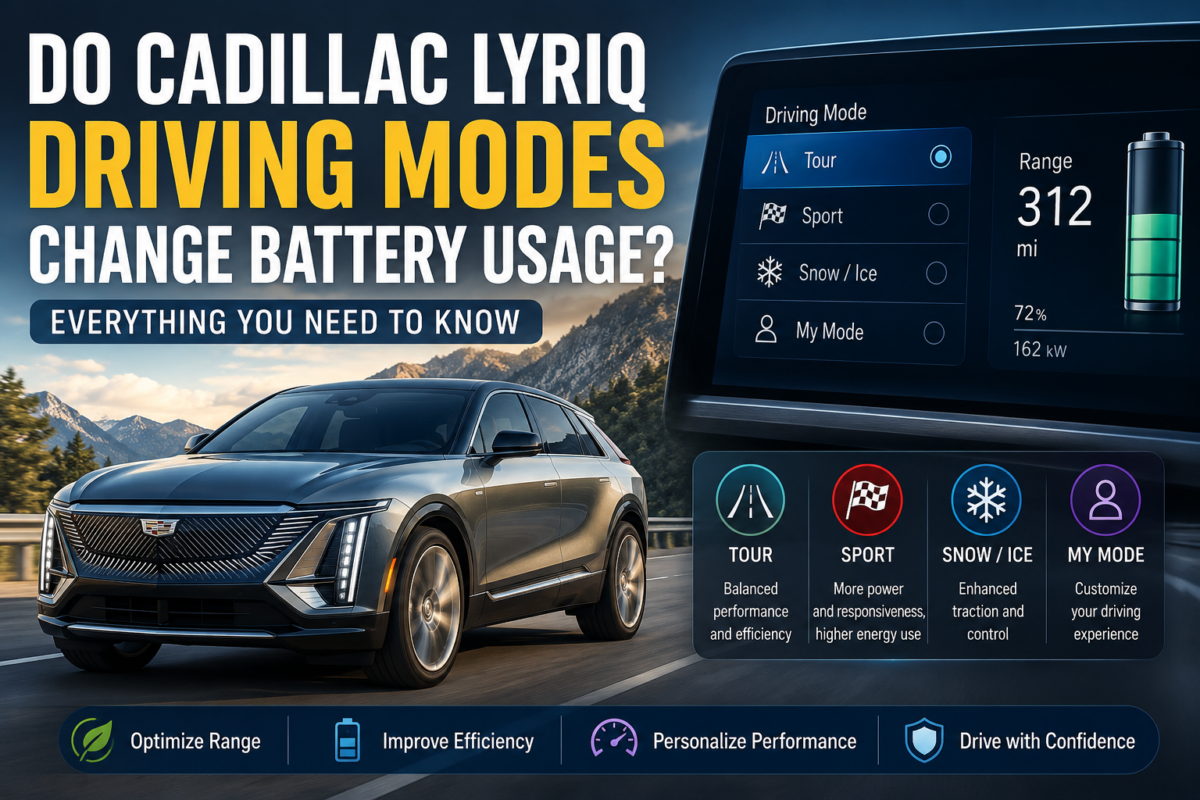
Electric vehicles have fundamentally changed the way drivers think about efficiency, performance, and energy consumption. In traditional gasoline-powered vehicles, fuel economy often depended on engine size, transmission design, and driving habits. In modern electric vehicles such as the Cadillac Lyriq, software has become just as important as hardware. One of the most common questions among prospective buyers and current owners is: Do Cadillac Lyriq driving modes change battery usage?
The answer is yes—but the reality is far more nuanced than many drivers realize.
Driving modes in the Cadillac Lyriq do not alter the battery’s physical capacity. A fully charged battery remains the same regardless of whether the vehicle is operating in Tour, Sport, Snow/Ice, or My Mode. However, these modes significantly influence how the vehicle delivers power, responds to accelerator inputs, manages regenerative braking, and ultimately consumes energy during real-world driving.
As electric vehicles become increasingly sophisticated, manufacturers are leveraging software to create personalized driving experiences. Cadillac has positioned the Lyriq as a luxury electric SUV that combines premium comfort with cutting-edge technology. Its driving modes are a perfect example of how software can transform the character of a vehicle while simultaneously affecting efficiency and range.
Understanding these differences is important for anyone hoping to maximize range, reduce charging frequency, or optimize vehicle performance. Whether you’re commuting through city traffic, cruising on the highway, navigating winter roads, or enjoying spirited driving on winding roads, the selected driving mode can have a measurable impact on how efficiently the Lyriq uses energy.
This guide explores how Cadillac Lyriq driving modes work, why they affect battery consumption, which mode offers the best efficiency, and what owners can realistically expect from each setting.
Understanding Cadillac Lyriq Driving Modes
The Cadillac Lyriq is built on General Motors’ Ultium electric vehicle platform, a flexible architecture designed to maximize performance, efficiency, and software integration.
Unlike conventional vehicles that rely on mechanical adjustments, the Lyriq uses advanced electronic control systems to modify driving characteristics. These systems influence motor output, throttle sensitivity, regenerative braking intensity, steering feel, and traction management.
Depending on the model year and configuration, drivers can choose from several primary driving modes:
Tour Mode
Tour Mode serves as the default everyday setting. It balances comfort, efficiency, and responsiveness while prioritizing smooth acceleration and predictable energy consumption.
Sport Mode
Sport Mode increases throttle sensitivity and delivers more immediate acceleration. The vehicle feels more responsive, and power is made available more aggressively.
Snow/Ice Mode
Designed for low-traction conditions, Snow/Ice Mode reduces wheel spin by softening throttle response and optimizing traction control systems.
My Mode
My Mode allows drivers to customize steering feel, acceleration response, and other driving characteristics according to personal preferences.
Each mode creates a distinct driving experience, but they also influence how quickly energy is drawn from the battery pack.
Why Driving Modes Affect Battery Usage
To understand battery consumption, it is important to understand where energy goes in an electric vehicle.
Every time the driver presses the accelerator, electrical energy flows from the battery to the electric motor. The rate at which energy is delivered depends largely on software instructions.
Sport Mode encourages rapid power delivery. Faster acceleration requires higher energy output, which can increase battery consumption. In contrast, Tour Mode delivers power more gradually, helping maintain efficiency.
The relationship is similar to a smartphone. Running basic applications consumes little power, while demanding gaming applications drain the battery more quickly. The battery itself remains unchanged, but how energy is used determines how long it lasts.
The Cadillac Lyriq applies the same principle on a much larger scale.
Tour Mode: The Best Choice for Maximum Range
For most drivers seeking maximum efficiency, Tour Mode is typically the optimal setting.
Cadillac engineers designed Tour Mode to provide a balance between performance and energy conservation. Acceleration remains smooth and confident, but the vehicle avoids unnecessary bursts of power that can reduce efficiency.
In urban environments, Tour Mode helps drivers maintain consistent energy consumption while taking advantage of regenerative braking systems. During highway driving, the mode encourages steady power delivery, which can contribute to better overall range.
Many Lyriq owners report that Tour Mode provides the most predictable battery performance and range estimates.
The reason is simple. Electric vehicles are most efficient when acceleration is controlled and consistent. Tour Mode naturally promotes this driving style.
Sport Mode: More Performance, Higher Energy Consumption
Sport Mode transforms the Cadillac Lyriq into a noticeably more dynamic vehicle.
Acceleration becomes sharper, throttle response becomes more immediate, and the vehicle feels significantly more eager. This is particularly noticeable in dual-motor all-wheel-drive versions, which already produce impressive power figures.
The tradeoff is increased energy usage.
Rapid acceleration demands higher power output from the battery pack. Even though electric motors are highly efficient, generating strong bursts of acceleration requires more energy than gradual acceleration.
Drivers who frequently use Sport Mode often experience:
- Faster battery depletion
- Slightly reduced range
- More aggressive energy consumption patterns
- Increased performance responsiveness
The difference may not always be dramatic during short trips. However, over hundreds of miles, the cumulative impact becomes noticeable.
For drivers prioritizing excitement over efficiency, Sport Mode delivers an engaging luxury EV experience. For drivers focused on maximizing range, Tour Mode remains the superior choice.
Snow/Ice Mode and Its Impact on Efficiency
Snow and ice create unique challenges for electric vehicles.
In slippery conditions, sudden power delivery can lead to wheel spin and reduced vehicle control. Snow/Ice Mode addresses this by moderating throttle response and adjusting traction control parameters.
Interestingly, Snow/Ice Mode can sometimes improve efficiency in low-speed winter driving because it discourages aggressive acceleration.
However, winter itself introduces larger efficiency challenges than the driving mode.
Cold temperatures affect battery chemistry, reducing available energy and increasing charging times. Cabin heating also consumes significant electricity.
As a result, any efficiency gains from Snow/Ice Mode are often overshadowed by environmental factors.
The primary purpose of Snow/Ice Mode is safety rather than range optimization.
The Role of Regenerative Braking
One of the most important factors affecting battery usage in the Cadillac Lyriq is regenerative braking.
Unlike traditional vehicles that waste kinetic energy as heat, electric vehicles can recover part of that energy and return it to the battery.
When the driver lifts off the accelerator, the electric motor functions as a generator. Energy that would otherwise be lost is converted back into stored electricity.
The Lyriq offers adjustable regenerative braking options, including one-pedal driving.
Drivers who master regenerative braking techniques can significantly improve real-world efficiency regardless of driving mode.
In many cases, driving behavior has a greater impact on range than the selected mode itself.
A driver using Sport Mode gently may achieve better efficiency than a Tour Mode driver who accelerates aggressively at every traffic light.
Real-World Range Differences Between Driving Modes
Many drivers expect dramatic differences in range between modes, but real-world testing often reveals more moderate results.
Under identical conditions, Tour Mode generally delivers the best efficiency.
Sport Mode may reduce overall range by several percentage points, depending on driving style.
The actual difference depends on factors such as:
- Driving speed
- Traffic conditions
- Terrain
- Outside temperature
- Use of climate controls
- Tire pressure
- Driver behavior
For example, a driver cruising steadily at highway speeds may notice only a small difference between Tour and Sport modes. In contrast, frequent acceleration in city traffic can amplify the impact.
The mode itself does not directly consume energy. Instead, it influences how the driver accesses the vehicle’s available performance.
Driving Modes vs Driving Habits
One of the biggest misconceptions among EV owners is that vehicle settings determine efficiency more than driver behavior.
In reality, driving habits remain the most important factor.
Consider two Lyriq owners:
The first driver uses Sport Mode but accelerates smoothly and anticipates traffic conditions.
The second driver uses Tour Mode but repeatedly accelerates aggressively and brakes hard.
The first driver may achieve better efficiency despite using the supposedly less economical mode.
This illustrates an important principle in electric vehicle ownership: software influences efficiency, but human behavior ultimately determines outcomes.
Comparing the Lyriq to Other Luxury Electric SUVs
The Cadillac Lyriq is not unique in offering multiple driving modes.
Tesla, BMW, Mercedes-Benz, Audi, and Genesis all provide adjustable performance profiles.
Tesla’s Chill Mode prioritizes efficiency by reducing acceleration aggressiveness.
Mercedes-Benz offers Eco, Comfort, Sport, and Individual modes.
BMW’s electric models feature Efficient, Personal, and Sport settings.
Across the industry, the pattern remains consistent. Efficiency-focused modes generally improve range, while performance-focused modes consume more energy.
The Lyriq’s implementation is particularly refined because it balances luxury comfort with substantial performance without making efficiency sacrifices feel restrictive.
Benefits of Using the Right Driving Mode
Selecting the appropriate mode can improve the overall ownership experience.
Drivers focused on long-distance travel may prefer Tour Mode for its predictable efficiency.
Those navigating challenging winter conditions benefit from Snow/Ice Mode’s enhanced stability.
Performance enthusiasts can enjoy Sport Mode when acceleration and responsiveness matter most.
The flexibility allows a single vehicle to adapt to multiple driving scenarios without requiring hardware changes.
This adaptability is one of the greatest advantages of software-defined electric vehicles.
Challenges and Misconceptions
Many consumers assume that changing modes creates dramatic range differences.
While the impact is real, it is usually smaller than factors such as:
- Weather conditions
- Driving speed
- Tire condition
- HVAC usage
- Elevation changes
Another misconception is that Sport Mode is inherently inefficient.
In reality, the mode simply provides access to more aggressive performance. If used responsibly, efficiency losses can remain relatively modest.
Understanding these nuances helps drivers make informed decisions rather than relying on assumptions.
The Future of Intelligent Energy Management
The future of electric vehicles will likely move beyond simple driving modes.
Artificial intelligence and predictive software are already being integrated into next-generation EV platforms.
Future versions of systems like those found in the Cadillac Lyriq may automatically adjust energy management based on:
- Navigation routes
- Traffic conditions
- Weather forecasts
- Driver behavior patterns
- Battery temperature
Instead of selecting a mode manually, vehicles may continuously optimize efficiency and performance in real time.
This evolution represents the next stage in electric mobility, where software becomes an increasingly important contributor to range and energy management.
Frequently Asked Questions
Do Cadillac Lyriq driving modes affect battery range?
Yes. Driving modes influence power delivery and vehicle responsiveness, which can affect energy consumption and real-world driving range.
Which Cadillac Lyriq mode provides the best range?
Tour Mode generally offers the best balance of efficiency and comfort, making it the preferred choice for maximizing range.
Does Sport Mode drain the battery faster?
Sport Mode can increase energy consumption because it encourages more aggressive acceleration and faster power delivery.
Does Snow/Ice Mode save battery power?
Snow/Ice Mode is designed primarily for traction and safety. Any efficiency benefits are typically secondary.
Can regenerative braking improve Lyriq range?
Yes. Effective use of regenerative braking helps recover energy and extend driving range.
Does My Mode affect battery consumption?
It can. Customized settings that emphasize performance may increase energy usage, while efficiency-oriented configurations may conserve power.
Are driving modes more important than driving habits?
No. Driving habits usually have a greater impact on efficiency and range than driving mode selection alone.
Will future Cadillac EVs have smarter energy management?
Industry trends suggest that future EVs will use AI-driven systems to optimize efficiency automatically based on real-time conditions.
Conclusion
The question of whether Cadillac Lyriq driving modes change battery usage reveals an important truth about modern electric vehicles: software now plays a central role in determining how efficiently energy is used.
While driving modes do not alter battery capacity, they significantly influence how power is delivered, how aggressively the vehicle accelerates, and how efficiently energy is consumed during everyday driving. Tour Mode remains the most range-friendly option for most drivers, while Sport Mode prioritizes responsiveness and excitement at the cost of somewhat higher energy consumption. Snow/Ice Mode enhances stability in difficult weather conditions, and My Mode provides a customizable balance between performance and efficiency.
Yet perhaps the most important lesson is that driving behavior matters more than any setting. Smooth acceleration, intelligent use of regenerative braking, proper tire maintenance, and efficient route planning often have a greater impact on range than the selected driving mode alone.
As the automotive industry continues its transition toward software-defined vehicles, systems like those found in the Cadillac Lyriq will become increasingly sophisticated. Future electric vehicles will likely use artificial intelligence, predictive analytics, and real-time optimization to manage energy more effectively than ever before.
For today’s Lyriq owners, understanding how driving modes affect battery usage provides a practical advantage. By choosing the right mode for the right situation and adopting efficient driving habits, drivers can maximize range, enhance performance when desired, and enjoy the full potential of Cadillac’s luxury electric SUV.