Can Chickens Eat Potato Skins? The Surprising Truth for Your Flock
July 7, 2026
Success100x.com Factors: Complete Guide to 100x Personal and Business Growth
July 9, 2026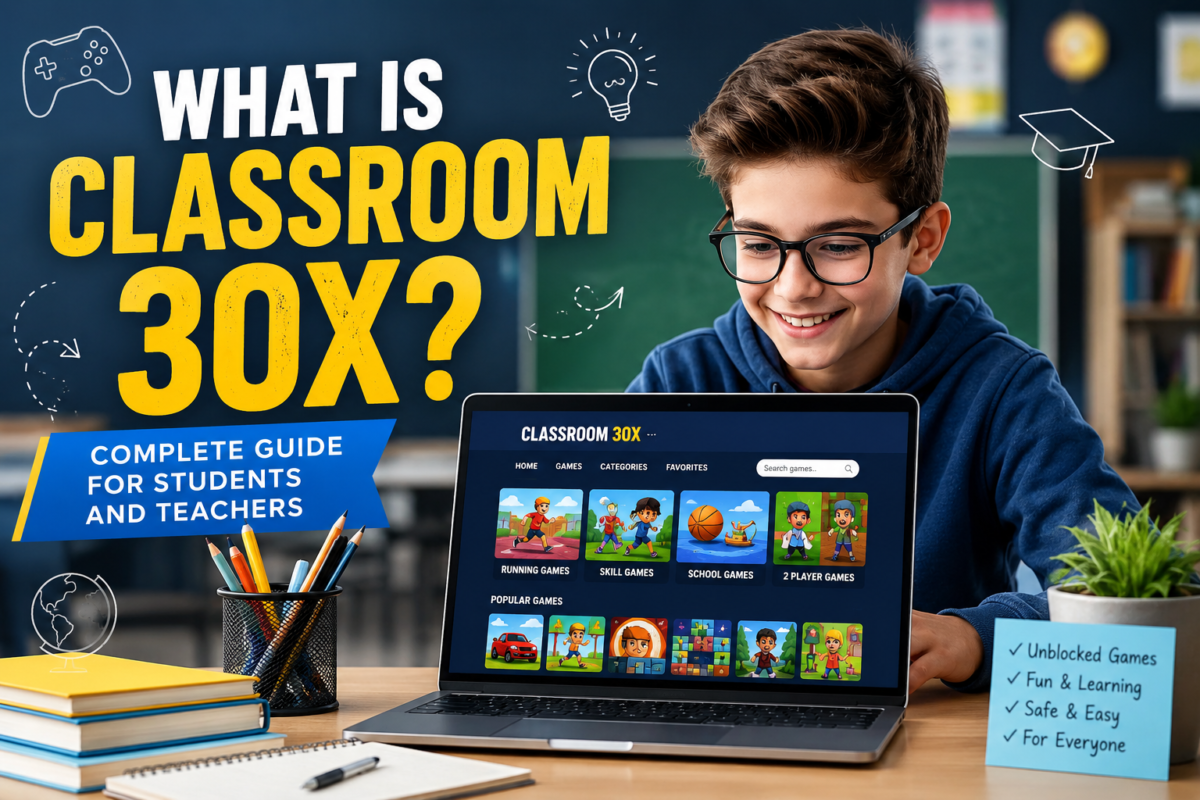
The phrase Classroom 30x sits at the intersection of two very different conversations happening in education right now. On one side, students search for it as a fast, browser-based place to play free online games, often on school Chromebooks or restricted networks. On the other side, teachers and parents see names like Classroom 30x and ask a more serious question: is this a harmless break-time website, a learning tool, or another distraction dressed in educational language?
That tension is exactly why Classroom 30x matters. The modern classroom is no longer limited to textbooks, worksheets, and whiteboards. Students now move between Google Classroom, digital assignments, browser games, learning apps, video lessons, and AI-powered tools in the same school day. In that environment, platforms that offer “unblocked games,” “school games,” “skill games,” and “no-download browser play” can spread quickly because they match the habits of today’s students: instant access, short sessions, simple controls, and no installation barriers. Classroom 30X describes itself as a destination for free, unblocked HTML5 games, with categories such as running games, school games, skill games, and two-player games.
But the real story is bigger than one website. Classroom 30x reflects a wider shift in how students use the web during school hours, how game-based learning is being discussed, and how educators must separate meaningful digital engagement from low-value screen time. Some pages online present Classroom 30x as an interactive learning platform, while others frame it more directly as an unblocked games site. That difference matters because students, teachers, and parents need clear expectations before deciding whether it belongs in an educational setting.
This complete guide explains what Classroom 30x is, how it works, why students search for it, what teachers should know, and how schools can approach it responsibly.
What Is Classroom 30x?
Classroom 30x is commonly used to describe a browser-based online gaming destination associated with free, unblocked games that can be played without downloading software. In practical terms, most users searching for Classroom 30x are looking for quick-access web games that run directly inside a browser, often on Chromebooks, laptops, tablets, or school computers.
The phrase is sometimes presented online in a broader educational way, with claims that Classroom 30x supports interactive learning, gamified engagement, and classroom-friendly play. However, the most visible use of the term is closely tied to unblocked browser games. The official-looking Classroom 30X GitHub-hosted page describes the platform as a place for free, unblocked HTML5 games and highlights categories such as skill games, running games, school games, and two-player games.
That distinction is important. A platform can include games that develop reaction time, logic, coordination, or problem-solving, but that does not automatically make it a structured educational platform. True educational technology usually includes learning objectives, teacher controls, student progress tracking, curriculum alignment, assessment tools, and privacy safeguards. Many unblocked game sites do not offer those features in a formal way.
For students, Classroom 30x often means entertainment during breaks or free time. For teachers, it raises questions about focus, classroom management, digital safety, and whether any games on the site can be used constructively. For parents, it may simply be another unfamiliar website their child has discovered through school or friends.
The best way to understand Classroom 30x is not to label it as either “good” or “bad,” but to place it in context. It is part of a larger web culture where students search for quick, accessible, low-friction gaming experiences. Some of those experiences may be harmless in moderation. Some may even encourage useful skills. But without guidance, they can also become distractions.
Why Students Search for Classroom 30x
Students are drawn to Classroom 30x for the same reasons they are drawn to many browser-based gaming sites: speed, simplicity, and accessibility. A student does not need to create an account, install an app, buy a console, or download a large file. The appeal is immediate. Open the page, choose a game, and start playing.
This type of frictionless design fits perfectly with school devices, especially Chromebooks. Many students use devices that are locked down by school administrators. App stores may be disabled, downloads may be restricted, and entertainment platforms may be blocked. Browser games, especially lightweight HTML5 games, fill that gap because they often run directly inside a web page.
Another reason Classroom 30x gains attention is social discovery. Students share game links through group chats, classroom conversations, Discord servers, comments, or search suggestions. Once a site becomes known as a place where games “work at school,” the name spreads quickly. This is similar to how other unblocked game brands, such as Classroom 6x, became popular by offering large collections of no-download browser games. Classroom 6x, for example, promotes hundreds of free unblocked games with no signup and instant browser play.
The psychology is simple: students want small moments of autonomy during structured school days. Games give them quick feedback, visible progress, challenge, competition, and reward. Compared with passive scrolling, many games feel more active and satisfying. A five-minute puzzle game, racing game, or reaction-based challenge can feel like a mental reset.
The problem begins when those short breaks expand into hidden distractions. If students use Classroom 30x during lessons, assessments, or independent work time, the platform becomes less like a recreational tool and more like a classroom management issue. The same design qualities that make it convenient also make it easy to misuse.
How Classroom 30x Works
Classroom 30x works through the browser. Instead of requiring a dedicated app, the games are usually embedded in web pages and played using keyboard, mouse, touchpad, or touchscreen controls. Many modern browser games use HTML5, a web technology that replaced older plugin-based formats such as Flash. HTML5 games are popular because they can run across different devices without requiring special installation.
The core user experience is straightforward. A visitor opens the site, browses a category, selects a game, waits for it to load, and begins playing. Categories often help users find specific types of games, such as racing, skill, puzzle, sports, action, running, or two-player games. Classroom 30X pages describe skill games as games that test reaction time, logic, accuracy, timing, hand-eye coordination, and strategic thinking.
This structure is one reason unblocked game sites grow so quickly. They do not ask users to understand complex menus or learning dashboards. They remove every barrier between search intent and action. A student who searches “classroom 30x” is usually not looking for a long explanation. They want a working page with playable games.
For teachers, that simplicity creates both opportunity and risk. On the positive side, lightweight browser games can be used for short brain breaks, reward time, keyboard practice, problem-solving activities, or after-assignment enrichment. On the negative side, the same games can pull attention away from instruction when used without permission.
The technical simplicity also makes oversight harder. A site may appear under different domains, mirrors, GitHub pages, or Google Sites versions. Search results show multiple pages using the Classroom 30x name or related wording. Some may be official, some may be copies, and some may simply use the keyword for traffic. That means users should be careful about assuming every “Classroom 30x” result is the same platform or equally safe.
Is Classroom 30x an Educational Platform or an Unblocked Games Site?
The most accurate answer is that Classroom 30x is best understood as an unblocked games brand or web gaming destination, not a fully verified classroom learning management system. Some articles describe it as a gamified learning platform, but the strongest visible evidence points toward a browser game collection built around free, accessible play.
This does not mean it has no educational value. Many games can support skills that matter in learning environments. Puzzle games can develop pattern recognition. Strategy games can encourage planning. Timing-based games can improve coordination. Word or logic games can support vocabulary, reasoning, and persistence. Even simple games can teach students how to experiment, fail, adjust, and try again.
However, educational value depends on how a game is selected and used. A math game tied to a lesson is different from a racing game played during a lecture. A teacher-guided activity with reflection is different from unsupervised entertainment. The same game can be either constructive or disruptive depending on timing, purpose, and classroom rules.
This is where many online descriptions become confusing. Calling a platform “educational” does not automatically make every activity on it educational. Schools should ask practical questions. Does the platform clearly explain what students learn? Are games organized by subject or skill? Are there teacher controls? Is student data collected? Are ads present? Are external links safe? Can the teacher monitor usage?
If the answer to most of those questions is unclear, Classroom 30x should be treated carefully. It may still be useful for supervised breaks or limited recreational time, but it should not be confused with formal educational software unless a school has reviewed it properly.
Why Classroom 30x Became Part of the Bigger EdTech Conversation
The popularity of Classroom 30x connects to a broader transformation in education: the rise of gamification. Schools and edtech companies have spent years experimenting with ways to make learning more interactive, adaptive, and rewarding. From language-learning streaks to math platforms with badges, the logic is the same: students are more likely to participate when learning feels active rather than passive.
Research and educational design discussions increasingly recognize that games can support motivation when they are connected to clear goals. Digital escape rooms, for example, have been explored as immersive learning environments because they combine storytelling, problem-solving, and subject knowledge in a way that feels active and memorable. A 2024 paper on virtual reality educational escape rooms described a web framework designed to help educators create VR escape experiences that can be delivered through web-connected devices.
That does not mean every browser game is educational. It means the boundary between learning and play has become more complex. A generation raised on interactive screens often expects feedback, choice, challenge, and progression. Traditional worksheets may still be useful, but they compete with digital tools that offer instant response and emotional reward.
Classroom 30x benefits from this cultural shift. Even if many users visit primarily for entertainment, the site exists in a world where games are no longer dismissed entirely as wasted time. Teachers now understand that play can support learning when it is purposeful. The challenge is separating intentional game-based learning from random game consumption.
This is why Classroom 30x should be discussed seriously. It is not just another gaming keyword. It is a signal of how students navigate school technology, how web gaming adapts to restricted environments, and how educators must modernize digital expectations without losing control of the learning environment.
Benefits of Classroom 30x for Students
The strongest benefit of Classroom 30x is accessibility. Students can usually play directly from a browser without downloads, expensive hardware, or complicated accounts. This makes it easy for students using school laptops, Chromebooks, or shared devices to access games quickly.
A second benefit is variety. Game collections often include puzzle, reaction, sports, racing, platform, and two-player games. Different students enjoy different types of challenges. One student may prefer logic-based puzzles, while another may enjoy timing-based running games or competitive two-player games. This variety can make short breaks more engaging.
Classroom 30x may also support soft skills when used appropriately. Many browser games require persistence. Students fail, retry, improve, and learn through feedback. Puzzle and skill games can encourage problem-solving, timing, spatial awareness, decision-making, and pattern recognition. These are not the same as formal academic outcomes, but they are real cognitive activities.
There is also a social benefit. Two-player games or shared challenges can give students a low-pressure way to interact. In classrooms where teachers use structured reward time, games can become part of a positive classroom culture. A teacher might allow a few minutes of approved game time after a completed task, during indoor recess, or as part of a digital choice board.
But the key phrase is “used appropriately.” The benefits appear when Classroom 30x is limited, supervised, and clearly separated from instruction time. Without those boundaries, the platform can shift from a useful break into a habit that weakens attention.
Risks and Challenges Teachers Should Consider
The biggest challenge with Classroom 30x is distraction. Browser games are designed to be engaging. They use quick rewards, fast restarts, simple goals, and escalating difficulty to keep players involved. Those same features can make it difficult for students to stop when class resumes.
Another concern is the unclear quality and safety of game sites using similar names. Search results may include GitHub pages, Google Sites pages, copycat domains, and blog posts describing Classroom 30x in different ways. One Google Sites result, for example, lists many game titles and links under the Classroom 30x name. This fragmented landscape means teachers and parents should not assume that every page using the keyword has the same safety standards.
Advertising and external links are another issue. Some unblocked game websites rely on ads, redirects, or third-party embeds. Even if the games themselves are harmless, the surrounding web environment may not be ideal for students. Schools need to consider privacy, content appropriateness, tracking, pop-ups, and whether students may be pushed toward unrelated sites.
There is also a classroom equity issue. Some students can self-regulate digital entertainment; others struggle. A student who finishes work early may use games responsibly, while another may rush through assignments just to play. If teachers allow game access without structure, it can create uneven academic behavior.
Finally, there is the question of school policy. Many schools restrict gaming sites for a reason. Network filters are usually designed to protect instructional time, device security, and student safety. Students should not be encouraged to bypass school rules. If Classroom 30x is allowed, it should be through teacher approval and school policy, not hidden access.
Classroom 30x for Teachers: How to Use It Responsibly
Teachers who want to use Classroom 30x or similar sites should begin with purpose. The question should not be “Can students access it?” The better question is “What role does this serve in my classroom?”
For younger students, the safest use may be short, supervised reward time or indoor recess. For older students, teachers might use selected games as quick brain breaks between demanding tasks. A five-minute break after a writing assignment or math assessment can help students reset, but only if the time limit is firm.
Teachers can also create approved game lists. Instead of allowing students to browse freely, a teacher can review specific games in advance and choose only those that are age-appropriate, nonviolent, quick to play, and unlikely to lead to problematic content. This turns a chaotic open web experience into a controlled classroom tool.
Another effective approach is reflection. After a puzzle or strategy game, teachers can ask students what skill they used. Did they plan ahead? Notice patterns? Manage frustration? Improve through trial and error? This simple step turns play into metacognition. Students begin to see games not only as entertainment but as systems that require thinking.
Clear rules matter. Students should know when games are allowed, which games are approved, how long they can play, and what happens if they use them during instruction. The best digital classroom policies are not vague. They are specific, visible, and consistently enforced.
Teachers should also coordinate with administrators and IT staff. If a school blocks gaming sites, a teacher should not encourage students to work around filters. Instead, the teacher can request approval for specific educational games or safer alternatives. Responsible use begins with transparency.
Classroom 30x for Parents: What to Know at Home
For parents, Classroom 30x can be confusing because it sounds educational. The word “classroom” may suggest a school-approved platform, but parents should look more closely. In many cases, children searching for Classroom 30x are looking for unblocked games rather than formal lessons.
That does not mean parents need to panic. Playing browser games is not automatically harmful. The issue is balance, content, and context. A child who plays a few short games after homework is in a different situation from a child who hides gaming during schoolwork, avoids assignments, or becomes frustrated when asked to stop.
Parents should ask simple, direct questions. What games are you playing? When do you use the site? Did your teacher allow it? Does the site show ads? Do you chat with anyone there? Do you click outside the game page? These questions are more useful than simply banning the site without understanding how the child uses it.
Parents can also watch for behavior patterns. If Classroom 30x becomes a source of conflict, secrecy, late-night screen use, or declining school performance, it may need stricter limits. If it is simply part of occasional recreation, reasonable boundaries may be enough.
The best approach is not fear-based. It is media literacy. Children should understand that not every site with “classroom” in the name is school-approved, not every game is educational, and free websites may still collect attention, clicks, or data. Teaching that distinction is more valuable than focusing on one site alone.
Classroom 30x vs Classroom 6x and Other Alternatives
Classroom 30x is often searched alongside similar names such as Classroom 6x, unblocked games, school games, and Chromebook games. The comparison matters because many of these platforms serve the same basic demand: quick browser-based games that work on restricted or school-style devices.
Classroom 6x presents itself as a large free unblocked games platform with hundreds of browser games and no download or signup requirements. Classroom 30x uses similar language around free, unblocked, browser-based games. In practical terms, the difference for users may come down to game library, site reliability, page speed, device compatibility, and whether the site works on a particular network.
More education-focused alternatives include teacher-approved learning platforms, math game sites, typing practice tools, coding games, digital escape rooms, and curriculum-aligned apps. These tools may not always feel as open-ended as unblocked game collections, but they usually provide clearer educational value and better oversight.
The traditional model of school computer use was simple: students used devices for research, documents, presentations, and assignments. The modern model is messier. Students now expect interactive learning, and teachers often use games, quizzes, simulations, and apps to increase engagement. Classroom 30x fits into this modern environment, but it sits closer to recreational browser gaming than structured learning software.
That does not make alternatives automatically better. Some educational platforms are boring, over-controlled, or poorly designed. Some simple games are genuinely useful for focus and problem-solving. The real comparison should be based on purpose. If the goal is instruction, use a curriculum-aligned tool. If the goal is a short supervised break, a carefully selected browser game may be acceptable. If the goal is unsupervised entertainment during class, no platform is ideal.
Is Classroom 30x Safe?
Classroom 30x can be safe in a limited sense if students access appropriate games under adult supervision, avoid suspicious links, and follow school rules. But it should not be treated as automatically safe simply because it uses classroom-related branding.
Safety depends on several factors. The first is content. Are the games age-appropriate? Do they include violence, crude humor, gambling-like mechanics, or inappropriate themes? The second is advertising. Are there pop-ups, redirects, or ads that may lead students elsewhere? The third is data. Does the site collect personal information, use cookies, or connect to third-party services? The fourth is behavior. Are students using it at the right time and for the right reason?
Many unblocked game sites operate in a fast-moving web ecosystem. Pages can change, mirrors can appear, and copycat versions can use similar names. A teacher or parent reviewing Classroom 30x today may not see the same experience a student finds tomorrow through a different search result.
For schools, the safest path is review and approval. IT teams can evaluate domains, block unsafe mirrors, and allow only vetted educational resources. Teachers can select specific games instead of allowing unrestricted browsing. Parents can use device-level supervision tools at home.
The most important safety principle is this: students should not be taught to bypass restrictions. If a school blocks a site, the proper response is to ask a teacher or administrator for approved alternatives. Digital citizenship includes respecting boundaries, not just finding technical workarounds.
The Future of Classroom 30x and Browser-Based Learning
The future of Classroom 30x depends on whether platforms like it evolve from simple game collections into more responsible, structured learning environments. The demand is clearly there. Students like fast browser-based experiences. Teachers want engagement. Schools want tools that are safe, measurable, and aligned with learning outcomes.
The next phase of this market will likely reward platforms that combine entertainment with accountability. A future version of a Classroom 30x-style platform could include teacher dashboards, age filters, subject categories, ad-free school modes, privacy transparency, and learning objectives attached to each game. That would move it closer to legitimate edtech.
At the same time, schools are becoming more serious about digital wellbeing. After years of rapid technology adoption, many educators are asking harder questions about screen fatigue, attention, privacy, and the quality of digital learning. A platform will not succeed in schools simply because students like it. It must also satisfy teachers, parents, administrators, and regulators.
Game-based learning itself will continue to grow. Simulations, coding games, virtual labs, adaptive quizzes, and immersive educational environments are becoming more sophisticated. Research into digital educational experiences, including virtual escape rooms and interactive learning apps, shows that the future of learning will likely include more active digital participation, not less.
Classroom 30x is therefore part of a larger question: how much play belongs in learning? The answer is not zero. Play can be powerful. But the best educational play is designed, guided, and purposeful. The future belongs not to sites that merely avoid filters, but to platforms that earn trust.
Frequently Asked Questions About Classroom 30x
What is Classroom 30x?
Classroom 30x is commonly known as a browser-based site or web gaming destination associated with free unblocked games. Many students search for it to play games online without downloads or installations. Some online articles describe it as a gamified learning platform, but the most visible use of the term is connected to unblocked browser games.
Is Classroom 30x made for students?
Classroom 30x appears to target students and school-device users by offering quick browser games that can run on computers, tablets, and Chromebooks. However, that does not automatically mean it is officially approved by schools. Students should only use it when permitted by a teacher, parent, or school policy.
Is Classroom 30x educational?
Some games may support skills such as problem-solving, logic, reaction time, coordination, and persistence. However, Classroom 30x should not be considered a full educational platform unless specific games are reviewed and used with a clear learning purpose. Entertainment value and educational value are not the same thing.
Can teachers use Classroom 30x in class?
Teachers can use selected games responsibly for brain breaks, reward time, indoor recess, or skill-building activities, but they should review games first. It is better to approve specific games than to allow open browsing. Teachers should also follow school technology policies.
Is Classroom 30x safe for children?
It may be safe when supervised, but parents and teachers should be cautious. Safety depends on the specific site version, game content, ads, external links, privacy practices, and how students use it. Because similar names and mirror sites may exist, adults should review the exact page a child is using.
Does Classroom 30x require downloads?
The main appeal of Classroom 30x-style sites is that games usually run directly in the browser. This means students typically do not need to download apps or install software. That convenience is useful, but it also means students may access games quickly without much oversight.
Why do schools block sites like Classroom 30x?
Schools often block gaming sites to protect instructional time, reduce distractions, prevent unsafe content, and maintain network security. Blocking does not always mean every game is harmful; it usually means the school wants to control when and how digital entertainment is used.
What are better alternatives to Classroom 30x?
Better alternatives depend on the goal. For learning, teachers may prefer curriculum-aligned math games, typing tools, coding platforms, science simulations, or teacher-approved quiz apps. For short breaks, approved browser games may be acceptable. The best option is one that matches the age of the student, the classroom purpose, and school policy.
Conclusion
Classroom 30x is more than a search term for online games. It is a snapshot of how students experience the modern digital classroom: part learning environment, part entertainment space, part restricted network, and part social web. Students search for Classroom 30x because it offers what many digital natives expect: instant access, simple games, fast rewards, and no installation. Teachers and parents notice it because those same qualities can either support short, healthy breaks or create serious distraction.
The most balanced view is also the most useful one. Classroom 30x should not be exaggerated into a revolutionary learning platform without evidence, but it should not be dismissed as meaningless either. Some games can encourage focus, coordination, logic, persistence, and problem-solving. Under the right conditions, browser games can have a place in school life. But that place must be intentional.
For students, the lesson is responsibility. Games belong in approved moments, not hidden behind assignments or used to avoid learning. For teachers, the opportunity is structure. Instead of fighting every digital distraction one by one, educators can create clear rules, approved choices, and purposeful uses of play. For parents, the priority is awareness. A classroom-sounding name does not guarantee educational value, and a game site should be judged by content, safety, and behavior.
The future of platforms like Classroom 30x will depend on trust. If they become safer, more transparent, and more genuinely educational, they may find a stronger role in digital learning. If they remain mostly unstructured game collections, they will continue to live in the gray area between recreation and distraction.
The real question is not whether students will keep searching for games. They will. The real question is whether schools and families can guide that curiosity into healthier, smarter, and more purposeful digital habits.