
Who Is Eileen Tate? The Untold Story of Andrew Tate’s Mother
June 11, 2026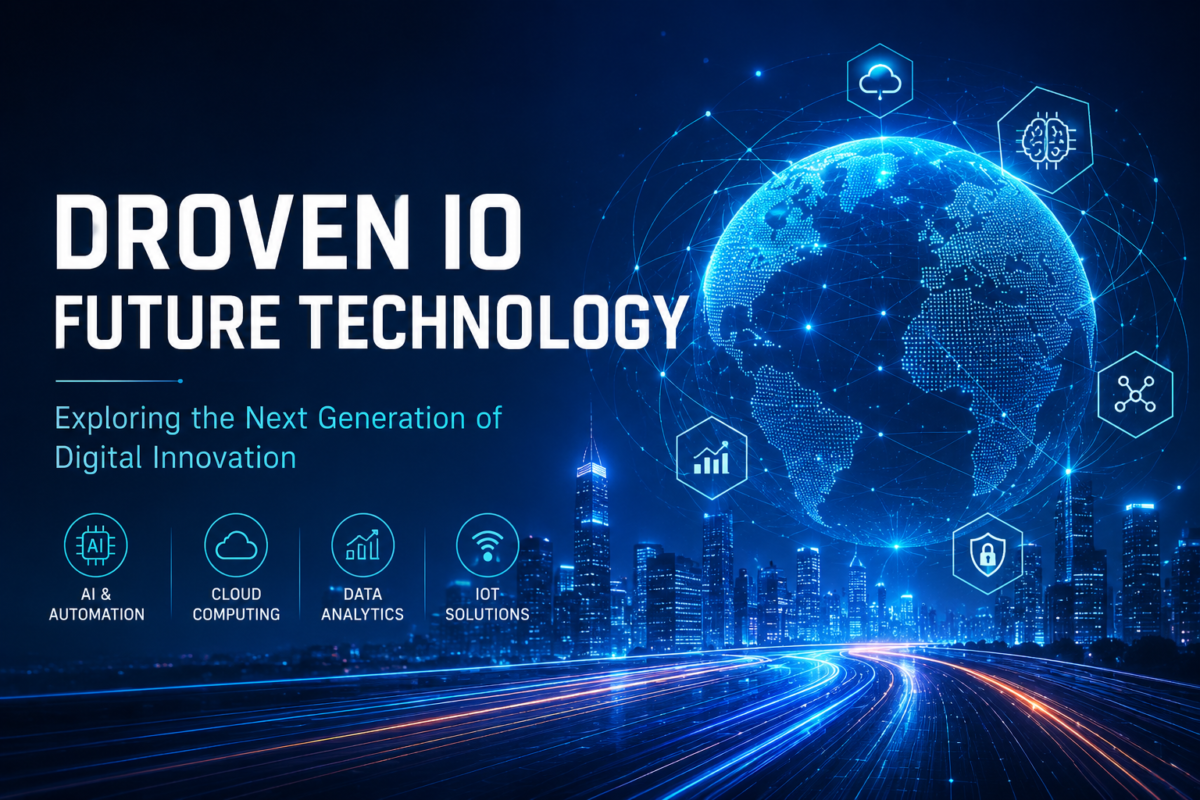
Technology is evolving faster than at any other point in human history. What seemed futuristic a decade ago has now become a part of daily life. Artificial intelligence writes content, cloud platforms run global businesses, smart devices communicate with each other, and advanced analytics help organizations predict customer behavior before decisions are even made. As digital transformation accelerates across industries, new technology ecosystems are emerging to redefine how businesses operate and compete. One such emerging concept attracting attention is Droven IO Future Technology.
The growing interest surrounding Droven IO Future Technology reflects a broader movement toward intelligent, connected, and data-driven innovation. Organizations are no longer satisfied with traditional software systems that simply store information or automate repetitive tasks. Instead, they are seeking platforms capable of learning, adapting, and making intelligent recommendations in real time. This shift is creating entirely new opportunities for businesses, governments, and consumers.
As organizations continue investing in artificial intelligence, automation, cloud computing, cybersecurity, and predictive analytics, technologies associated with future-focused digital ecosystems are expected to become increasingly influential. Understanding the principles behind Droven IO Future Technology offers valuable insight into where digital innovation is heading and how businesses can prepare for the next generation of technological transformation.
The Evolution of Digital Innovation
The digital landscape has undergone remarkable changes over the past two decades. Early digital transformation efforts focused primarily on replacing paper-based processes with digital systems. Businesses adopted websites, email communication, customer databases, and enterprise software to improve operational efficiency. While these technologies delivered significant benefits, they were often limited by their inability to learn or adapt.
The emergence of cloud computing changed everything. Companies suddenly gained access to scalable infrastructure without massive upfront investments. At the same time, advances in artificial intelligence and machine learning enabled software systems to analyze enormous amounts of data and uncover insights that humans might miss.
Today, innovation extends beyond simple automation. Modern technology ecosystems are increasingly capable of making predictions, identifying patterns, and supporting decision-making processes. This evolution represents the foundation upon which concepts such as Droven IO Future Technology are built.
Rather than focusing solely on operational efficiency, future technologies aim to create intelligent environments where systems continuously learn from data and improve their performance over time. This marks a significant shift from reactive technology toward predictive and adaptive digital ecosystems.
Understanding Droven IO Future Technology
Droven IO Future Technology can be viewed as a modern framework for digital innovation that combines advanced technologies to create smarter and more connected systems. At its core, it represents the convergence of artificial intelligence, cloud infrastructure, automation, big data analytics, cybersecurity, and emerging digital technologies.
Unlike traditional software solutions that operate independently, future technology ecosystems are designed to work collaboratively. Data flows seamlessly between applications, devices, and platforms, creating a unified environment capable of generating real-time insights.
This interconnected approach allows organizations to improve operational efficiency while simultaneously enhancing customer experiences. Instead of relying on manual decision-making processes, businesses can leverage intelligent systems that analyze data continuously and provide recommendations based on evolving conditions.
The value of this approach becomes increasingly apparent as organizations face growing complexity. Whether managing global supply chains, financial operations, healthcare systems, or customer interactions, businesses require technology capable of handling massive volumes of information and converting that information into actionable intelligence.
Artificial Intelligence as the Driving Force
No discussion of future technology would be complete without examining the role of artificial intelligence. AI has become one of the most transformative technologies of the modern era, influencing virtually every industry.
Artificial intelligence enables machines to perform tasks traditionally requiring human intelligence. These tasks include language processing, image recognition, predictive analysis, decision-making, and pattern identification. Through machine learning algorithms, AI systems improve their performance over time as they process more data.
Within the framework of Droven IO Future Technology, artificial intelligence serves as the engine that powers intelligent automation and predictive insights. Businesses can use AI to forecast demand, optimize pricing strategies, improve customer support, and identify emerging market opportunities.
Major technology companies such as Google, Microsoft, Amazon, and NVIDIA have invested billions of dollars in AI research because they recognize its transformative potential. As AI models become more sophisticated, their integration into future technology ecosystems will continue to accelerate.
The rise of generative AI has further expanded possibilities. Organizations can now generate content, automate customer interactions, develop software code, and streamline creative workflows at unprecedented speed. These capabilities are fundamentally changing how businesses operate and compete.
Cloud Computing and Scalable Infrastructure
Cloud computing represents another critical pillar of future technology ecosystems. Traditional IT infrastructure often required significant investments in servers, maintenance, and technical personnel. Cloud technology has transformed this model by providing flexible, on-demand access to computing resources.
Organizations can now deploy applications globally within minutes while scaling resources according to demand. This flexibility enables businesses to innovate more quickly and respond effectively to changing market conditions.
For future technology platforms, cloud infrastructure provides the foundation necessary to support massive data processing, AI workloads, and real-time analytics. Without cloud computing, many of today’s advanced digital capabilities would be impractical or prohibitively expensive.
Furthermore, cloud platforms facilitate collaboration across geographical boundaries. Teams can access information from anywhere in the world, creating new opportunities for remote work and global business operations.
The Growing Importance of Data Intelligence
Data has become one of the most valuable assets in the modern economy. Every online interaction, transaction, and connected device generates information that can provide valuable insights.
However, collecting data alone is not enough. Organizations must be able to interpret and act upon that information effectively. This is where advanced analytics and data intelligence play a crucial role.
Future technology ecosystems are designed to process large volumes of structured and unstructured data in real time. Through sophisticated analytics tools, organizations can identify trends, predict outcomes, and make informed decisions.
Retail companies use data intelligence to personalize customer experiences. Financial institutions analyze transaction patterns to detect fraud. Manufacturers monitor equipment performance to predict maintenance needs before failures occur.
The ability to transform raw data into strategic intelligence provides organizations with a significant competitive advantage. As data volumes continue growing, technologies capable of extracting meaningful insights will become increasingly valuable.
Industry Applications and Real-World Impact
The influence of future technology extends far beyond the technology sector itself. Virtually every industry is experiencing transformation through intelligent digital solutions.
Healthcare organizations are leveraging AI-powered diagnostic tools to improve patient outcomes and accelerate disease detection. Advanced analytics help medical professionals identify risk factors and develop personalized treatment plans. Remote monitoring systems enable healthcare providers to track patient health in real time, improving accessibility and reducing costs.
In the financial sector, intelligent systems are revolutionizing banking operations. Fraud detection algorithms can identify suspicious activities within seconds, while predictive analytics help institutions assess credit risk more accurately. Digital banking platforms provide seamless customer experiences while reducing operational overhead.
Manufacturing companies are embracing Industry 4.0 technologies that combine robotics, IoT devices, and predictive analytics. Smart factories can monitor production processes continuously, optimize efficiency, and minimize downtime through predictive maintenance.
The retail industry has also undergone significant transformation. Personalized recommendations, dynamic pricing strategies, and AI-powered customer support systems are enhancing shopping experiences while increasing revenue opportunities.
These examples demonstrate how future technology ecosystems are creating measurable value across diverse sectors.
Challenges and Considerations
While the opportunities associated with future technology are substantial, organizations must also address several important challenges.
Cybersecurity remains one of the most significant concerns. As digital systems become increasingly interconnected, potential attack surfaces expand. Businesses must invest in robust security frameworks capable of protecting sensitive information and maintaining customer trust.
Data privacy presents another critical consideration. Consumers are becoming increasingly aware of how their information is collected and used. Organizations must comply with evolving regulations while maintaining transparency and ethical data practices.
The rapid pace of technological change also creates workforce challenges. Many organizations struggle to find professionals with expertise in artificial intelligence, cloud computing, cybersecurity, and advanced analytics. Addressing these skill gaps requires ongoing investment in education and workforce development.
Additionally, the integration of emerging technologies with legacy systems can be complex and costly. Organizations must develop thoughtful implementation strategies that balance innovation with operational stability.
Emerging Trends Shaping the Future
Several technology trends are expected to influence the evolution of Droven IO Future Technology over the coming decade.
Generative AI is likely to continue expanding into new areas of business operations, content creation, software development, and customer engagement. Organizations will increasingly rely on AI-driven systems to improve productivity and reduce costs.
Edge computing is gaining importance as connected devices generate massive amounts of data. By processing information closer to its source, organizations can reduce latency and improve system performance.
Digital twin technology is creating virtual representations of physical systems, enabling businesses to simulate scenarios and optimize operations before implementing changes in the real world.
Quantum computing, while still in its early stages, has the potential to solve complex problems that exceed the capabilities of traditional computers. Although widespread adoption may take years, its long-term impact could be revolutionary.
Hyperautomation is another trend expected to gain momentum. By combining artificial intelligence, robotic process automation, and advanced analytics, organizations can automate increasingly complex workflows.
The Future Outlook
The future of digital innovation will likely be defined by intelligent, interconnected systems capable of learning, adapting, and evolving. Technologies associated with Droven IO Future Technology align closely with this vision.
Organizations that successfully embrace these innovations will be better positioned to compete in rapidly changing markets. They will benefit from improved efficiency, enhanced decision-making capabilities, stronger customer relationships, and greater operational agility.
At the same time, responsible implementation will remain essential. Businesses must prioritize cybersecurity, ethical AI practices, data privacy, and workforce development to ensure sustainable success.
The next decade promises unprecedented technological advancement. As artificial intelligence, cloud computing, data intelligence, and automation continue to mature, future technology ecosystems will become increasingly central to business strategy and economic growth.
Frequently Asked Questions
What is Droven IO Future Technology?
Droven IO Future Technology refers to an emerging approach to digital innovation that combines artificial intelligence, automation, cloud computing, data analytics, and intelligent systems to improve business operations and drive transformation.
Why is future technology important for businesses?
Future technology helps organizations increase efficiency, enhance customer experiences, improve decision-making, reduce costs, and remain competitive in rapidly evolving markets.
How does artificial intelligence support future technology?
AI enables predictive analytics, intelligent automation, machine learning, natural language processing, and real-time decision support, making digital systems smarter and more adaptive.
Which industries benefit most from future technology?
Healthcare, finance, manufacturing, retail, education, logistics, and telecommunications are among the industries experiencing significant benefits from advanced digital technologies.
What are the biggest challenges of implementing future technology?
Common challenges include cybersecurity risks, data privacy concerns, skill shortages, implementation complexity, and integration with existing systems.
What role does cloud computing play in digital transformation?
Cloud computing provides scalable infrastructure, global accessibility, cost efficiency, and flexibility, enabling organizations to deploy and manage advanced digital solutions.
Is automation replacing human workers?
Automation is changing the nature of work rather than eliminating it entirely. Many routine tasks are being automated, while new opportunities are emerging in technology management, AI development, and digital innovation.
What technologies will define the next decade?
Artificial intelligence, generative AI, quantum computing, edge computing, digital twins, blockchain, and hyperautomation are expected to shape the future of digital innovation.
Conclusion
Droven IO Future Technology represents a vision of the future where intelligent systems, advanced analytics, cloud infrastructure, and artificial intelligence work together to create smarter and more adaptive digital ecosystems. As organizations continue navigating an increasingly complex and competitive environment, the ability to leverage these technologies effectively will become a critical differentiator.
The convergence of AI, automation, big data, cybersecurity, and cloud computing is not simply transforming individual industries—it is reshaping the global economy. Businesses that invest strategically in innovation today will be better prepared to capitalize on tomorrow’s opportunities. While challenges related to privacy, security, and workforce adaptation remain important considerations, the long-term potential of future technology is undeniable.
As the next generation of digital innovation unfolds, Droven IO Future Technology symbolizes the growing shift toward intelligent, connected, and data-driven solutions that have the power to redefine how businesses operate, innovate, and succeed in the years ahead.