
Colby Donaldson Net Worth: Inside the Life, Career, and Earnings of the Survivor Legend
July 4, 2026
What Is Kibard? Meaning, Origin, and Why People Search for It
July 6, 2026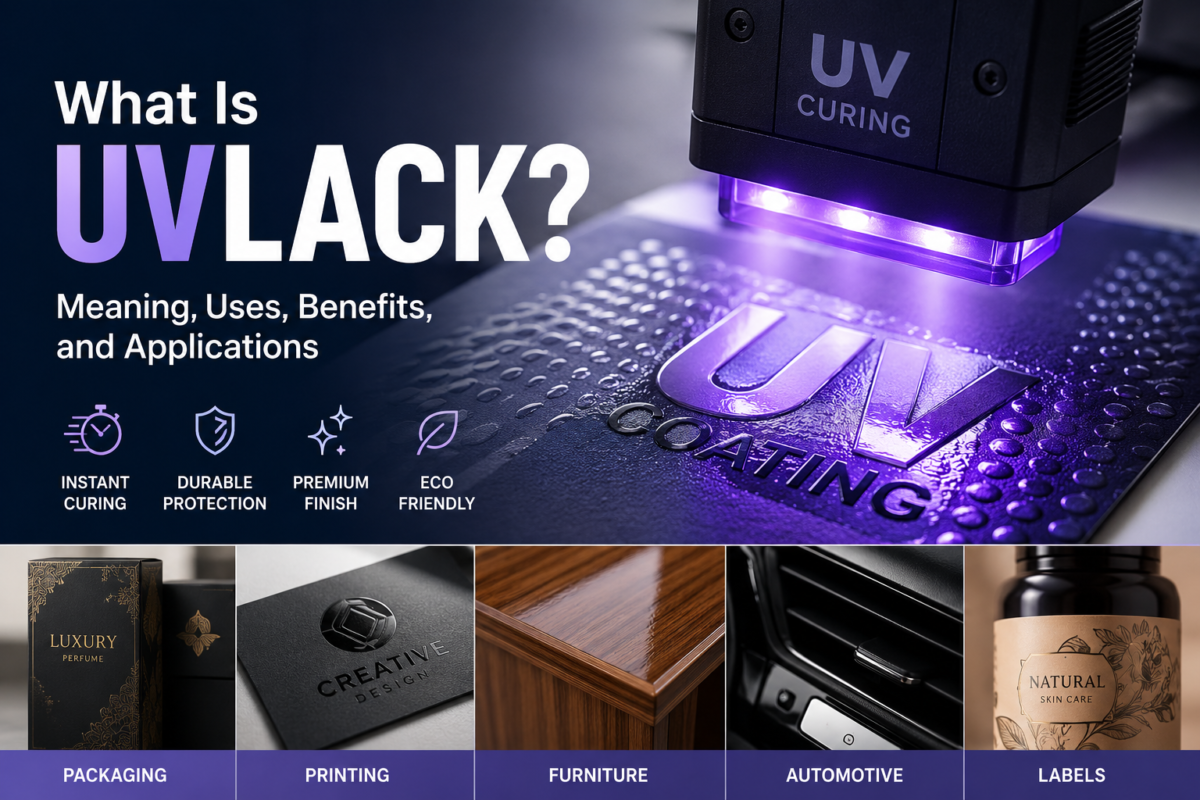
In modern manufacturing, the finish on a product is no longer just a final layer. It is part of the product’s identity, durability, cost structure, environmental profile, and customer experience. A luxury perfume box feels premium before the bottle is opened because the surface catches light in a certain way. A high-end business card makes an impression because the logo has a raised shine against a matte background. A cabinet door survives daily cleaning, fingerprints, and abrasion because its coating forms a tough protective film. Behind many of these details is a fast-curing technology often referred to as Uvlack.
Uvlack, commonly written as UV-Lack in German-speaking markets, generally means UV lacquer, UV varnish, or UV-curable coating. It is a liquid coating applied to a surface and then hardened almost instantly under ultraviolet light. Instead of drying slowly through air exposure, heat, or solvent evaporation, Uvlack cures through a photochemical reaction. This makes it valuable in industries where speed, precision, appearance, and surface protection matter.
The rise of Uvlack is closely tied to larger shifts in manufacturing. Businesses want faster production lines, lower volatile organic compound emissions, premium finishes, and coatings that can perform across paper, plastic, wood, metal, packaging, labels, furniture, automotive interiors, and electronics. UV-curable coatings are used across markets such as automotive, printing ink, wood, aerospace, and metal finishing, with industry research tracking continued growth through 2030 and beyond.
What makes Uvlack especially interesting is that it sits at the intersection of chemistry, design, sustainability, and industrial efficiency. It is both a technical coating system and a branding tool. It can make a printed package look more expensive, protect a wood panel from wear, reduce drying bottlenecks in production, and help manufacturers move toward cleaner finishing processes. To understand Uvlack properly, it is not enough to define it. We need to look at how it works, why industries use it, where it performs best, and what challenges still shape its future.
What Is Uvlack?
Uvlack is a UV-curable lacquer or coating that hardens when exposed to ultraviolet light. The word comes from UV-Lack, where “Lack” means lacquer or varnish in German. In practical terms, it refers to a coating system designed to create a protective and decorative surface layer after UV curing.
A typical Uvlack formulation contains resins, oligomers, monomers, photoinitiators, and additives. Each part has a specific role. Resins and oligomers help form the body of the coating. Monomers influence flow, viscosity, and curing behavior. Photoinitiators are the key reactive components that respond to UV light. Additives can adjust gloss, scratch resistance, slip, adhesion, flexibility, texture, or chemical resistance.
When Uvlack is applied to a surface, it remains liquid until exposed to the correct UV energy. Once the UV light reaches the photoinitiators, they generate reactive species that trigger polymerization. The liquid coating rapidly transforms into a solid crosslinked film. This curing process can happen in seconds, which is why UV coatings are widely used in high-speed industrial environments.
This is the main difference between Uvlack and traditional coatings. Conventional varnishes often dry through solvent evaporation, oxidation, moisture reaction, or heat-assisted curing. These processes can take minutes, hours, or even days depending on the coating thickness, environment, and substrate. Uvlack compresses that timeline dramatically. In many production settings, a coated product can move almost immediately to the next stage after UV exposure.
That instant curing capability is one reason UV varnish has become common in printing and packaging. It allows printers to apply gloss, matte, or spot effects without slowing the production line. It also improves handling resistance, which matters when printed materials are stacked, folded, cut, shipped, or displayed.
How Uvlack Works
The science behind Uvlack is based on photopolymerization. The coating starts as a liquid mixture that contains molecules capable of linking together. UV light acts as the trigger. When the coating passes under a UV lamp or UV-LED system, photoinitiators absorb the light energy and begin a rapid chemical reaction. That reaction links the coating components into a durable polymer network.
The result is not simply a “dried” layer. It is a cured film. This distinction matters because drying usually means a liquid loses solvent or water. Curing means the coating chemically changes into a new solid structure. A properly cured Uvlack layer can offer stronger resistance to abrasion, moisture, chemicals, and handling than many standard surface treatments.
The process depends heavily on formulation and equipment. The coating must be matched with the right UV wavelength, lamp intensity, exposure time, substrate, film thickness, and production speed. If the light does not penetrate properly, the coating may remain undercured. If the energy is too aggressive, heat-sensitive materials can distort or discolor. Manufacturers must balance performance with process control.
Historically, many UV curing systems used mercury vapor lamps. These lamps are powerful but generate heat and require careful handling. In recent years, UV-LED curing has gained attention because it can offer lower heat output, improved energy efficiency, longer lamp life, and more precise wavelength control. Current industry discussions around UV-curable coatings frequently highlight LED UV curing as an important development, especially for sustainability-focused and high-speed manufacturing.
This shift is important because it expands where Uvlack can be used. Lower-heat curing can be more suitable for temperature-sensitive films, plastics, labels, and thin packaging materials. It also supports automation because UV-LED systems can be integrated into controlled production lines with consistent output and reduced maintenance compared with some older curing technologies.
Why Uvlack Matters in Modern Manufacturing
Uvlack matters because manufacturers are under pressure from several directions at once. They need products to look better, last longer, move faster through production, and meet stricter environmental expectations. A coating technology that can improve surface quality while reducing curing time naturally becomes attractive.
Speed is one of the strongest advantages. In printing, packaging, furniture, and industrial finishing, drying time can become a bottleneck. If coated sheets, panels, or components need hours to dry, they occupy space and slow the entire production flow. Uvlack can reduce or remove that waiting period. This allows faster turnaround, smaller work-in-progress inventory, and more efficient use of factory space.
Appearance is another major factor. Uvlack can create a range of finishes, from high-gloss and satin to matte, textured, soft-touch, and spot effects. In consumer packaging, this can influence buying behavior. A cosmetic box with selective UV shine over a logo can look more premium. A book cover with contrast between matte lamination and glossy UV elements can feel more tactile and memorable. A label with UV varnish can resist handling while maintaining visual sharpness.
Durability also drives adoption. Surfaces are not passive. They are touched, rubbed, cleaned, stacked, transported, and exposed to light, moisture, and chemicals. Uvlack can strengthen the surface layer and help preserve the look of printed graphics, wood finishes, plastic parts, and industrial components.
Environmental pressure is equally important. Many UV-curable coating systems are designed with low or no solvent content, which can reduce volatile organic compound emissions compared with traditional solvent-based coatings. UV curing is often discussed as an energy-efficient and more environmentally favorable finishing method because it can avoid long oven-drying cycles and reduce solvent evaporation concerns.
That does not mean every Uvlack system is automatically sustainable or risk-free. Formulations still need to be evaluated for raw material sourcing, worker safety, recyclability impact, migration risk in food packaging, and end-of-life considerations. But as an industrial direction, UV-curable coatings align with the broader movement toward faster, cleaner, and more resource-efficient production.
Common Uses and Applications of Uvlack
One of the reasons Uvlack has become widely discussed is its versatility. It is not limited to one industry or one surface. It can be engineered for paper, board, plastic film, wood, metal, composite materials, labels, and specialty products.
In printing and packaging, Uvlack is often used as a finishing varnish. It can cover an entire printed sheet or appear only in selected areas as spot UV. Full UV coating gives the printed surface extra gloss, protection, and depth. Spot UV creates contrast, often highlighting logos, patterns, product names, or design elements. This is common in luxury packaging, business cards, brochures, magazine covers, presentation folders, labels, and folding cartons.
In commercial packaging, Uvlack plays both a protective and marketing role. A product box must survive handling, shipping, shelf display, and customer interaction. At the same time, it must communicate quality in seconds. UV varnish can intensify colors, protect ink from scuffing, and create a finish that feels more refined.
In furniture and woodworking, UV-curable coatings are used on panels, cabinets, flooring components, doors, decorative boards, and ready-to-assemble furniture. These applications benefit from fast curing, surface hardness, abrasion resistance, and consistent finish quality. Wood products often need coatings that preserve visual appeal while protecting against wear. Uvlack can help deliver a clear, smooth, and durable surface without long drying periods.
In automotive interiors, UV-curable coatings are increasingly relevant for trim parts, decorative panels, plastic components, and touch surfaces. The automotive sector needs coatings that resist abrasion, chemicals, sunlight, and repeated human contact. Recent industry commentary has connected UV-LED curing with automotive interior coatings because it can support low-VOC finishing, rapid curing, and high wear resistance.
In electronics and industrial products, UV-curable coatings and related UV materials can be used for protective layers, adhesives, inks, encapsulants, and surface finishes. Electronics manufacturing values speed, precision, and controlled curing. UV systems can be useful when manufacturers need fast processing without exposing components to excessive heat for long periods.
In labels and flexible packaging, Uvlack helps protect printed surfaces while enhancing appearance. Labels on cosmetics, beverages, household products, and premium consumer goods often need resistance to moisture, rubbing, and handling. UV varnish can protect the printed design and create a finish that supports the brand’s visual identity.
Uvlack in Printing and Packaging
Printing and packaging are among the most visible uses of Uvlack because consumers interact with the results daily. A glossy catalog cover, a luxury product box, a wine label, a cosmetics carton, or a business card with shiny raised details may all use UV varnish or a related UV coating.
In offset, flexographic, screen, and digital printing workflows, UV coating is often applied after ink has been laid down. It can be used as an overall protective coating or as a design effect. Spot UV is especially popular because it creates contrast. A matte black business card with a glossy UV logo feels different from a standard printed card. The effect is subtle but powerful because it engages both sight and touch.
Packaging designers use Uvlack because surface finish shapes perception. Consumers often make judgments about quality before they read detailed product information. A sharp gloss, smooth satin layer, or tactile varnish can suggest care, precision, and premium positioning. In crowded retail environments, those details can help a product stand out.
There is also a practical reason. Printed materials are vulnerable to scuffing, fingerprints, moisture, and abrasion. Uvlack can protect ink and extend the life of printed surfaces. This is especially useful for packaging that moves through distribution networks or products that are handled repeatedly in stores.
However, packaging applications require careful technical decisions. Food packaging, pharmaceutical packaging, and sensitive consumer products may require coatings that meet specific migration and safety standards. The wrong coating or incomplete curing can create odor, transfer, or compliance problems. For that reason, professional converters choose formulations based on substrate, end use, regulatory requirements, curing system, and performance testing.
Uvlack vs Traditional Varnish and Coatings
The biggest difference between Uvlack and traditional varnish is the curing mechanism. Traditional coatings often rely on evaporation, oxidation, heat, or chemical reaction over time. Uvlack cures rapidly when exposed to UV energy. That difference affects production speed, finish quality, energy use, factory layout, and environmental performance.
Traditional solvent-based coatings can perform well and remain important in many industries, but they often require ventilation, drying time, and solvent management. Water-based coatings can reduce solvent concerns, but drying still depends on removing water, which can require heat and time. Two-component systems can offer strong durability but may involve pot-life limits, mixing requirements, and longer cure schedules.
Uvlack changes the rhythm of production. Because curing can occur almost instantly, manufacturers can move coated products directly into cutting, stacking, packing, or assembly. This is especially valuable in high-volume operations where every delay multiplies cost.
The finish properties are also different. UV-cured coatings often produce hard, smooth, highly resistant surfaces. They can be formulated for gloss, matte, texture, slip, flexibility, or adhesion. In many cases, they provide excellent appearance and strong surface protection with a relatively thin coating layer.
But Uvlack is not always the best solution. It requires UV curing equipment, process knowledge, and formulation control. It may struggle with shadowed areas, complex 3D shapes, highly opaque coatings, or substrates that block UV penetration. Traditional coatings can still be better for certain shapes, field applications, porous materials, or very thick films where UV light cannot reach the full coating depth.
The choice is not simply old versus new. It is about matching the coating technology to the product, production process, compliance requirements, performance targets, and cost model.
Benefits of Uvlack
The first major benefit of Uvlack is speed. Rapid curing can transform production economics. A company printing premium packaging, finishing furniture panels, or coating plastic components can reduce waiting time and increase throughput. In competitive industries, faster turnaround can be a serious advantage.
The second benefit is finish quality. Uvlack can create high visual impact. Gloss UV can make colors appear deeper and more vibrant. Matte UV can create understated elegance. Spot UV can add contrast and luxury. Textured or tactile UV coatings can make surfaces more memorable.
The third benefit is durability. A properly formulated and cured Uvlack layer can improve resistance to abrasion, scratching, moisture, chemicals, fingerprints, and repeated handling. This matters in packaging, furniture, flooring, labels, and industrial components where surface damage can quickly reduce perceived value.
The fourth benefit is environmental potential. UV-curable coatings are often associated with lower VOC emissions because many systems avoid high solvent content. They can also reduce energy demand when they replace long thermal drying processes. Industry research and technical reviews frequently connect UV-curable coatings with solvent reduction, energy efficiency, fast curing, and sustainable manufacturing opportunities.
The fifth benefit is process efficiency. UV systems can reduce floor space used for drying racks, ovens, or curing zones. Products can be handled sooner, waste from smudging or blocking can decline, and production lines can become more compact.
For brands, the benefit is strategic. Uvlack can help products look premium without changing the underlying material. A standard paperboard package can gain depth, contrast, and tactile interest through coating design. A furniture panel can achieve a durable, consistent finish at scale. A label can feel more refined and survive more handling.
Limitations, Risks, and Challenges
Despite its advantages, Uvlack is not a universal solution. The most important limitation is that UV curing requires light exposure. If UV light cannot reach part of the coating, that area may not cure properly. This can be an issue with complex shapes, deep recesses, shadowed surfaces, dark pigments, thick coatings, and opaque materials.
Curing depth is another challenge. UV light has limited penetration. Coatings must be formulated and applied at a thickness that allows proper curing. If the coating is too thick or heavily pigmented, the surface may cure while deeper layers remain soft or reactive. Technical sources often note that limited curing depth is one of the constraints of UV-curable systems, even as newer LED systems and formulations continue to improve performance.
Adhesion can also be difficult on certain substrates. Plastics, metals, coated papers, and films may need surface treatment, primers, or specialized formulations. A coating that performs beautifully on one substrate may fail on another. This is why testing is essential before full-scale production.
Equipment cost is another consideration. UV curing requires lamps or LED curing systems, shielding, process controls, and maintenance. For high-volume manufacturers, the investment can pay off through speed and efficiency. For small shops or occasional users, the cost may be harder to justify.
Worker safety and process safety must also be managed. UV light exposure can harm skin and eyes, so curing systems require proper shielding and procedures. Uncured coating materials may irritate skin or require careful handling. Ventilation, protective equipment, training, and safety data review are important.
In packaging, especially food-related packaging, migration and odor concerns require serious attention. A UV coating must be fully cured and appropriate for the intended use. Low-migration formulations may be necessary for certain applications. Premium appearance is not enough; compliance and safety matter.
Recycling and sustainability can also be complex. While Uvlack may reduce VOC emissions and curing energy, coatings can affect recyclability depending on the substrate, coating chemistry, and recycling stream. Sustainability claims should be specific rather than broad. A responsible manufacturer evaluates the full lifecycle, not just the curing speed.
Market Trends and Industry Developments
The broader UV-curable coatings market is growing because it aligns with several industrial priorities: speed, durability, automation, lower emissions, and high-quality surface finishing. Market analysis tracks UV-cured coatings across resin types such as epoxy, polyester, urethane, and other systems, with applications in automotive, printing ink, metal, wood, aerospace, and additional sectors.
One major trend is the movement toward UV-LED curing. LED systems can offer targeted wavelengths, lower heat, energy savings, and longer service life. This has opened new possibilities for heat-sensitive materials and more compact curing setups. It also supports digital printing and automated finishing lines, where consistent curing performance is essential.
Another trend is customization. Coatings are no longer expected to provide only gloss and protection. Brands and manufacturers increasingly want special effects: soft-touch surfaces, anti-fingerprint finishes, scratch-resistant layers, textured coatings, low-gloss luxury finishes, and high-contrast spot effects. Uvlack formulations can be adjusted to serve these needs.
Sustainability is also shaping the market. Manufacturers face pressure to reduce solvent emissions, energy use, and waste. UV-curable systems are part of that conversation because they can reduce drying time and solvent reliance. Industry reports estimate continued expansion in UV-curable coatings, with one forecast placing the UV curable coatings market at USD 7.2 billion in 2025 and USD 14.9 billion by 2035.
Automation is another driver. In smart factories, coating systems must work reliably at high speed with minimal variability. Uvlack fits well into production lines where instant curing, digital control, and repeatability are valuable. The ability to cure on demand makes UV coatings compatible with modern manufacturing logic.
At the same time, the industry is working through challenges around raw materials, regulatory scrutiny, migration safety, recyclability, and performance on difficult substrates. The future of Uvlack will likely depend not only on better curing equipment but also on smarter chemistry.
How Businesses Should Choose the Right Uvlack System
Choosing Uvlack is not just a purchasing decision. It is an engineering decision. The right coating depends on the surface, product use, curing equipment, appearance target, regulatory environment, and production volume.
The first question is substrate compatibility. Paperboard, coated paper, plastic film, wood, metal, and composite materials all behave differently. A coating must wet the surface properly, adhere after curing, and remain stable under real-use conditions.
The second question is performance. A luxury box may need gloss and scuff resistance. A kitchen cabinet may need abrasion, moisture, and chemical resistance. A label may need flexibility and rub resistance. An automotive trim part may need UV stability, scratch resistance, and low odor. Each application requires different formulation priorities.
The third question is curing setup. Mercury lamps and UV-LED systems do not behave the same way. Coatings must be matched to lamp wavelength and energy output. A coating designed for one curing system may not cure properly under another.
The fourth question is compliance. Products used near food, cosmetics, children’s items, medical packaging, or electronics may require special standards. Businesses should work with coating suppliers who can provide technical data, safety documentation, and application guidance.
The fifth question is total cost. Uvlack may cost more per liter than some traditional coatings, but the economics can improve through faster curing, lower energy use, less waste, reduced handling damage, and higher product value. The real calculation is not coating price alone. It is total process value.
The Future of Uvlack
The future of Uvlack will be shaped by three forces: sustainability, performance, and digital manufacturing.
Sustainability will push the industry toward lower-emission formulations, safer photoinitiators, improved recyclability, and more energy-efficient curing. As brands become more careful about environmental claims, coating suppliers will need to provide clearer data. The most successful Uvlack systems will be those that combine measurable environmental advantages with reliable industrial performance.
Performance will continue to evolve. Manufacturers want coatings that are harder, more flexible, more scratch-resistant, more chemical-resistant, and more pleasant to touch. They also want coatings that work on difficult substrates and complex shapes. Advances in resin chemistry, photoinitiator systems, and hybrid curing may help solve some current limitations.
Digital manufacturing will create new opportunities. As digital printing, short-run packaging, personalization, and automated production grow, fast-curing coatings become more valuable. Uvlack can support premium customization without slowing production. Imagine packaging lines where every box can receive personalized graphics and selective UV effects in a tightly controlled digital workflow.
UV-LED curing will likely become even more important. Lower heat, longer lamp life, and energy efficiency make LED systems attractive for many applications. As LED-compatible formulations improve, the technology may expand further into flexible packaging, labels, wood finishing, automotive interiors, and specialty industrial coatings.
Still, the future will not be automatic. Uvlack must address concerns around incomplete curing, chemical migration, recycling compatibility, and worker safety. The winners in this market will be companies that treat UV lacquer not as a decorative shortcut but as a precision coating technology.
FAQs About Uvlack
What does Uvlack mean?
Uvlack usually means UV lacquer, UV varnish, or UV-curable coating. The term comes from “UV-Lack,” where “Lack” means lacquer or varnish in German. It refers to a coating that hardens when exposed to ultraviolet light.
Is Uvlack the same as UV varnish?
Yes, in many contexts Uvlack and UV varnish refer to the same type of surface finish. Both describe a liquid coating that cures under UV light to create a protective or decorative layer. The exact formulation can vary depending on whether it is used for printing, packaging, wood, plastic, metal, or industrial parts.
How does Uvlack cure?
Uvlack cures through photopolymerization. Photoinitiators inside the coating absorb UV light and trigger a chemical reaction that turns the liquid coating into a solid polymer film. This process can happen very quickly when the coating, UV lamp, exposure time, and substrate are properly matched.
Where is Uvlack most commonly used?
Uvlack is commonly used in printing, packaging, labels, business cards, luxury cartons, furniture panels, wood finishing, plastic parts, automotive interiors, electronics, and industrial coatings. Its main value is fast curing combined with attractive surface protection.
What are the main benefits of Uvlack?
The main benefits are rapid curing, premium appearance, improved surface durability, strong gloss or matte effects, resistance to handling wear, and potential environmental advantages compared with some solvent-heavy coating systems. It also helps manufacturers speed up production and reduce drying bottlenecks.
Is Uvlack environmentally friendly?
Uvlack can be more environmentally favorable than some traditional solvent-based coatings because many UV-curable systems have low solvent content and cure quickly without long thermal drying. However, sustainability depends on the exact formulation, curing energy, substrate, recycling impact, and end-use requirements.
What are the disadvantages of Uvlack?
The main disadvantages include the need for UV curing equipment, possible curing problems in shadowed or thick areas, limited penetration depth, substrate adhesion challenges, safety precautions for UV exposure, and compliance concerns in sensitive packaging applications.
Can Uvlack be used on wood?
Yes, UV-curable coatings are widely used in furniture and woodworking applications, including panels, cabinets, doors, flooring components, and decorative boards. The coating can provide a smooth, durable, and attractive finish, but the formulation must be matched to the wood surface and production process.
Conclusion
Uvlack is more than a glossy coating. It is a modern finishing technology that reflects where manufacturing is heading: faster, cleaner, more precise, more design-driven, and more performance-focused. At its simplest, Uvlack means a UV-curable lacquer that hardens under ultraviolet light. But its real significance lies in what that curing method makes possible.
For printers and packaging companies, Uvlack offers speed, protection, and premium visual effects. For furniture and wood manufacturers, it provides durable surfaces without long drying delays. For automotive, electronics, labels, and industrial products, it supports high-performance finishes that can be integrated into advanced production lines. Across these industries, the same core advantage appears again and again: a liquid coating becomes a functional surface almost instantly.
The technology is not without limits. Uvlack requires proper equipment, technical knowledge, safety controls, and careful formulation. It must be tested for adhesion, curing depth, compliance, durability, and environmental impact. Poorly chosen or poorly cured UV lacquer can create problems, especially in demanding applications such as food packaging or complex industrial parts.
Yet the direction is clear. As UV-LED curing improves, as formulations become more specialized, and as manufacturers look for lower-emission, high-speed finishing systems, Uvlack is likely to become even more important. Its future will not be defined only by shine or speed, but by smarter chemistry, better process control, and more responsible product design.
In a market where surfaces influence both performance and perception, Uvlack gives manufacturers a powerful tool. It protects, enhances, accelerates, and differentiates. That combination explains why UV lacquer has moved from a specialist finishing method to a serious technology shaping the future of packaging, printing, furniture, and industrial coatings.